M-Center: Central Hub for M-Bus, MQTT, Modbus TCP and Professional Energy Management
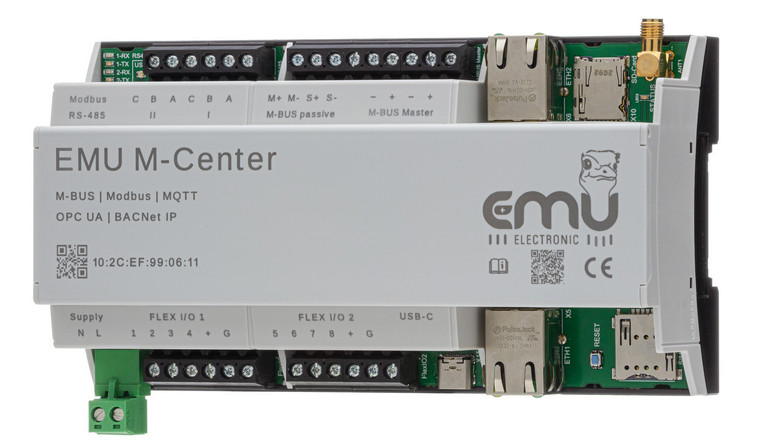
The EMU M-Center collects energy data from M-Bus and Modbus devices, transmits it via MQTT or Modbus TCP to higher-level systems, and works perfectly with the EMU Professional II series of 3-phase electricity meters. The result: less integration effort, greater transparency, and a strong foundation for submetering, building automation, and Joulio-Web.
Many energy projects do not fail because of the meters themselves, but because of missing system integration. Data is scattered across sub-distribution boards, utility meters, field devices, or isolated stand-alone solutions. This is exactly where the EMU M-Center comes in. It centrally consolidates measured values, integrates M-Bus and Modbus devices in a structured way, and makes the data available for building automation, IoT platforms, and energy management systems. Anyone looking for a scalable data hub for professional B2B projects will find the right solution here.
- Why the M-Center is so attractive for B2B projects
- MQTT and Modbus TCP: Taking data further with flexibility
- The perfect system solution with 3-phase electricity meters
- Typical applications in buildings and industry
- M-Center and Joulio-Web: From measured value to decision
- FAQ
- Conclusion
Why the M-Center is so attractive for B2B projects
The M-Center is much more than just a data logger. It is the central interface between the field level and the management level. The device is designed for up to 250 M-Bus devices and up to 64 Modbus RTU devices. This makes it suitable for small to large metering concepts in office buildings, industrial plants, municipal properties, and larger residential or commercial sites.
The major advantage lies in the system architecture: instead of integrating individual meters separately into BMS, SCADA, EMS, or cloud platforms, the M-Center takes over the centralized collection, preprocessing, and provision of data. This reduces integration effort, minimizes sources of error, and creates a clean, future-proof data foundation.
- Central data hub: One device for M-Bus, Modbus RTU, Modbus TCP, and additional integration requirements.
- Less complexity: Field devices are bundled centrally instead of being integrated into multiple systems individually.
- Scalable: Suitable for growing metering concepts and multi-site applications.
- Practical for real-world use: Web interface, service port, RS485, Flex I/O, and LAN simplify rollout and operation.
- Highly open system architecture: Ideal for building automation, submetering, and energy management.
MQTT and Modbus TCP: Taking data further with flexibility
The real strength of the M-Center becomes clear in the further processing of measured values. The device not only collects data, but also reliably delivers it to the systems where it is needed. Via MQTT, the M-Center can send data to a broker. According to the manual, MQTT 3.1, 3.1.1, and 5 are supported, as well as QoS 0, 1, and 2. This makes the product especially attractive for IoT architectures, cloud projects, and flexible monitoring solutions.
Modbus TCP functionality is just as relevant. With the appropriate license activated, the M-Center can operate as a Modbus TCP server and provide acquired values to downstream systems via port 502. This is ideal for building management systems, BMS, SCADA, and industrial visualization. Instead of connecting each metering point individually, the M-Center provides the data centrally and in a standardized format.
For operators and integrators, this means clear added value: fewer interfaces, less engineering effort, better data availability, and faster project implementation.
The perfect system solution with 3-phase electricity meters
The M-Center is particularly powerful when combined with EMU Metering’s 3-phase electricity meters. For classic M-Bus structures, the EMU Professional II 3/5 M-Bus is an obvious choice. For IP-based projects with direct network integration, the EMU Professional II 3/5 TCP/IP is a strong fit. When RS485 and Modbus RTU are the main focus, the EMU Professional II 3/5 Modbus complements the system perfectly.
This is where a real sales advantage emerges: the M-Center is not only compatible with these devices, but together with them it forms a logically structured EMU system solution. The electricity meters capture precise electrical measured values, the M-Center handles aggregation and communication, and Joulio-Web provides visualization, analysis, and reporting. This is attractive for customers because they are not buying a fragmented set of components, but a coordinated overall system.
Anyone who wants to create transparency across main and sub-distribution boards, analyze load profiles, or allocate consumption cleanly will benefit directly from this combination.
Typical applications in buildings and industry
The M-Center is ideal for projects in which multiple measuring devices, utility meters, and electricity meters need to be recorded centrally and integrated into higher-level systems. Typical application areas include:
- Submetering: Structured acquisition of main and sub-meters for electricity, water, heat, and other media.
- Building automation: Transfer of energy data to BACnet- or Modbus-TCP-based control systems.
- Energy monitoring: Creation of a reliable data foundation for analysis, peak load management, and efficiency projects.
- Modernization of existing facilities: Integration of existing infrastructure into a centralized digital architecture.
- IoT and cloud concepts: Data transmission via MQTT for dashboards, platforms, and external analytics.
M-Center and Joulio-Web: From measured value to decision
The M-Center reaches its full potential when combined with Joulio-Web. While the M-Center handles data acquisition and protocol integration, Joulio-Web makes the information visible and usable. Consumption trends, KPIs, analyses, and reports can be created far more efficiently than with manual processes or isolated single devices.
For companies, this means one thing above all: moving faster from measured value to action, gaining better transparency into energy flows, and building a much stronger basis for efficiency measures, billing, monitoring, and ISO 50001-related processes.
FAQ
What is the M-Center?
The M-Center is a central data logger and integration node for M-Bus, Modbus, and IP-based energy data. It collects, structures, and distributes measured values for energy management, submetering, and building automation.
Does the M-Center support MQTT?
Yes. The manual documents support for MQTT 3.1, 3.1.1, and 5, as well as QoS 0, 1, and 2. This makes the M-Center suitable for modern IoT and cloud connectivity.
Can the M-Center provide data via Modbus TCP?
Yes. With the corresponding license activated, the M-Center can operate as a Modbus TCP server and provide values to downstream systems.
Which electricity meters work especially well with the M-Center?
The M-Center works especially well with the 3-phase electricity meters of the EMU Professional II series, particularly the 3/5 M-Bus, 3/5 TCP/IP, and 3/5 Modbus versions.
What applications is the M-Center suitable for?
It is suitable for submetering, energy monitoring, building automation, modernization of existing installations, and the centralized provision of measured values in B2B energy projects.
The EMU M-Center is the ideal control hub for companies that want to combine M-Bus, MQTT, and Modbus TCP in one professional solution. In combination with the EMU Professional II 3/5 M-Bus, 3/5 TCP/IP, and 3/5 Modbus, as well as Joulio-Web, this creates a compelling EMU system solution for transparency, automation, and scalable energy management.