ISO 50001 certification: the path to a sustainable energy management system
At a time of rising energy prices, increasing cost pressure, and stricter regulatory requirements, systematic energy management is no longer an optional extra for companies, but a strategic necessity. The international ISO 50001 standard provides a proven framework for continuously improving energy efficiency, reducing costs, and meeting both internal and external requirements for energy management. For manufacturing companies, building operators, industrial sites, and organizations with multiple locations, a certified EnMS is an important step toward greater competitiveness and long-term sustainability.
- Why ISO 50001? Key benefits
- The path to certification: 4 phases of the PDCA cycle
- Data as the foundation: no improvement without measurement
- Software support: Joulio-Web from EMU Metering
- Conclusion: an investment that pays off
Why ISO 50001? Key benefits
An energy management system certified according to ISO 50001 is not just a formal certificate. It is a practical tool for creating transparency in energy consumption, identifying losses, defining EnPIs, and continuously improving processes over the long term. Companies benefit from lower energy costs, a stronger data foundation, greater transparency, and a more professional approach to audits and internal management. The standard also helps to structure responsibilities, documentation, and data-based decision-making.
- Cost reduction: systematic identification of efficiency measures leads to long-term reductions in energy consumption.
- Greater process reliability: energy becomes a measurable, documented, and more manageable area.
- Competitive advantage: organizations with a clearly structured EnMS identify optimization potential more quickly.
- Transparency: a detailed overview of energy flows supports better investment and operational decisions.
- Stronger image: responsible and verifiable energy management increases trust among customers and partners.
The path to certification: 4 phases of the PDCA cycle
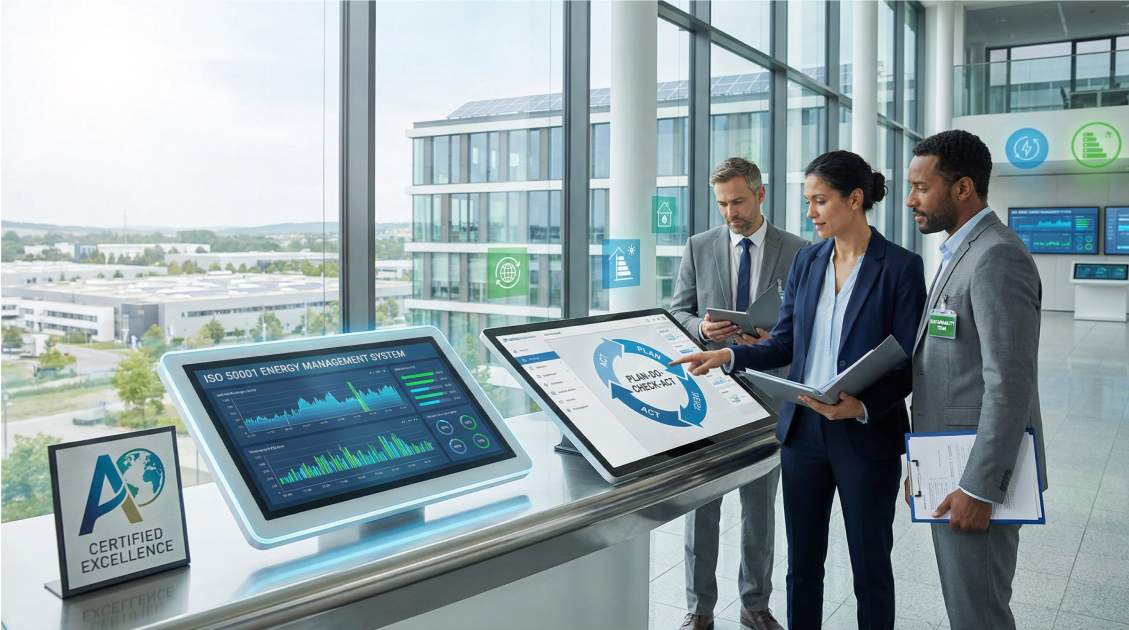
ISO 50001 is based on the Plan-Do-Check-Act model, in other words, the principle of continuous improvement. This logic turns energy management into a long-term system rather than a one-time project.
- Plan: you analyze energy consumption, identify significant energy uses, define objectives, and plan measures.
- Do: you implement the planned steps, provide resources, and involve employees.
- Check: you monitor results, measure consumption, evaluate data, and carry out internal audits.
- Act: you introduce corrective actions, adjust the strategy, and continue with further improvement.
Data as the foundation: no improvement without measurement
The foundation of every effective energy management system is precise and accessible data. Only organizations that know their energy consumption, load profiles, and main energy flows in detail can reliably identify savings potential and verify the effectiveness of their measures. That is why modern electricity meters and reliable data loggers and data acquisition solutions are essential for energy reviews, the development of EnPIs, and audit documentation.
Software support: Joulio-Web from EMU Metering
In practice, manual handling of large volumes of energy data, reports, and documentation is inefficient and error-prone. That is why professional software is a key component of a successful path to ISO 50001. Joulio-Web from EMU Metering supports automated data acquisition, clear visualization of consumption, trend analysis, reporting, and preparation for internal and external audits. In combination with the right metering technology, this creates a strong foundation for digital and sustainable energy management.
Conclusion: an investment that pays off
Implementing an energy management system in accordance with ISO 50001 is a strategic decision with long-term benefits. Companies gain better transparency, lower costs, and a stronger data foundation for operational optimization. With suitable electricity meters, reliable data acquisition, and intelligent software, the path to certification can be made significantly easier and more efficient.