MQTT with M-Center: intelligently forwarding measurement data from M-Bus, RS485 and Modbus TCP
The EMU M-Center reads measurement data from devices with M-Bus, RS485 or Modbus TCP interfaces and provides it via MQTT for modern IoT and energy management applications. This turns classic field communication into a future-ready data connection for cloud, monitoring and building automation.
In many energy projects, the real challenge is not the measurement itself, but the intelligent forwarding of the data. Meters and measuring devices reliably deliver their values via M-Bus, RS485 or Modbus TCP — but these values only become truly useful when they are cleanly integrated into higher-level systems. This is exactly where the EMU M-Center shows its strengths. It collects measurement data from different field interfaces and transfers it via MQTT into modern IoT, cloud and monitoring environments.
- Why MQTT is so relevant in energy management
- The M-Center as an interface hub for M-Bus, RS485 and Modbus TCP
- From field level to IoT level: rethinking measurement data with MQTT
- Typical applications in buildings, industry and infrastructure
- Benefits for integrators, operators and energy managers
- FAQ about M-Center with MQTT
- Conclusion: MQTT turns measurement data into usable energy data
Why MQTT is so relevant in energy management
MQTT has established itself as a lightweight and flexible protocol for transferring data to higher-level systems. In energy management, this is a major advantage: measurement values often need to be sent not only to local systems, but also to cloud platforms, IoT services, dashboards, databases or custom back-end environments.
The M-Center as an interface hub for M-Bus, RS485 and Modbus TCP
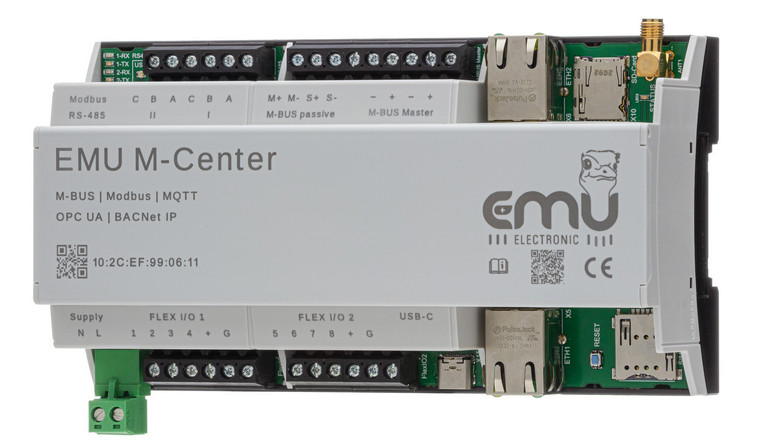
The M-Center is the technical hub between field level and IT or IoT level. Devices with M-Bus, RS485 / Modbus RTU or Modbus TCP can be connected and read centrally. This makes the M-Center ideal for mixed infrastructures in which not all devices use the same interface.
From field level to IoT level: rethinking measurement data with MQTT
The M-Center shows its real strength when the captured data is not only processed locally but also forwarded to other systems. With the optional MQTT function, measurement values from M-Bus and Modbus devices can be transferred directly to an MQTT broker. This allows classic energy data to be integrated into modern IoT architectures.
Typical applications in buildings, industry and infrastructure
- Building automation: collect measurement values from M-Bus and Modbus devices and pass them on to higher-level platforms.
- Energy monitoring: transfer consumption and load data to central dashboards or cloud systems.
- Industry: integrate field devices with RS485 and Modbus TCP into modern analysis and reporting environments.
- Multi-site solutions: standardized MQTT connectivity for centralized processing of energy data from several sites.
- IoT projects: use existing meters in new digital platform and data models.
Benefits for integrators, operators and energy managers
This approach offers several clear advantages. Integration effort is reduced because different field interfaces do not have to be connected separately to every target platform. Data availability increases because measurement values are captured centrally and forwarded in a structured way. At the same time, the architecture becomes more future-ready because MQTT provides a strong bridge between OT, building automation and IT.
FAQ about M-Center with MQTT
Can the M-Center forward measurement data via MQTT?
Yes. The M-Center can provide captured measurement data via MQTT for IoT, cloud and monitoring systems.
Which interfaces can the M-Center read?
The M-Center can read data from M-Bus, Modbus RTU and Modbus TCP devices.
Is the M-Center only suitable for electricity meters?
No. It can also read other measuring devices, provided they are integrated via M-Bus, Modbus RTU or Modbus TCP.
Why is MQTT interesting for energy management?
MQTT makes it easier to connect measurement data to modern platforms so that energy data can be visualized, analyzed and reused centrally.
Is the M-Center suitable for larger installations?
Yes. It is designed for larger measurement concepts and mixed infrastructures.
MQTT turns measurement data into usable energy data
The EMU M-Center is far more than a classic data logger. It reads measurement values from devices with M-Bus, RS485 and Modbus TCP interfaces and makes this data usable for modern systems via MQTT. This is the real added value: intelligently integrating existing metering technology, collecting energy data centrally and forwarding it into the digital world.